Search and relevance

Search profiles

Every setting of a search profile, what it does to results, and the mistakes to avoid.

What a profile is

A search profile is a saved recipe for one search box: which fields a query looks in and how much each counts, how forgiving it is about typos, which facets and sort orders it offers, which filters always apply and what each hit returns. An index can hold up to 50 profiles, for example one for the storefront search page and one for a B2B catalog.

Each profile has a profile key, 16 URL-safe characters that never change. The storefront sends searches to this key with only the query, filters, sort and page; everything else comes from the profile. A saved change applies to the very next search.

Create a profile

Only organization owners and admins can create and change profiles. Other members can open a profile and look at its settings.

  1. Open the index and click Search profiles, then New profile.
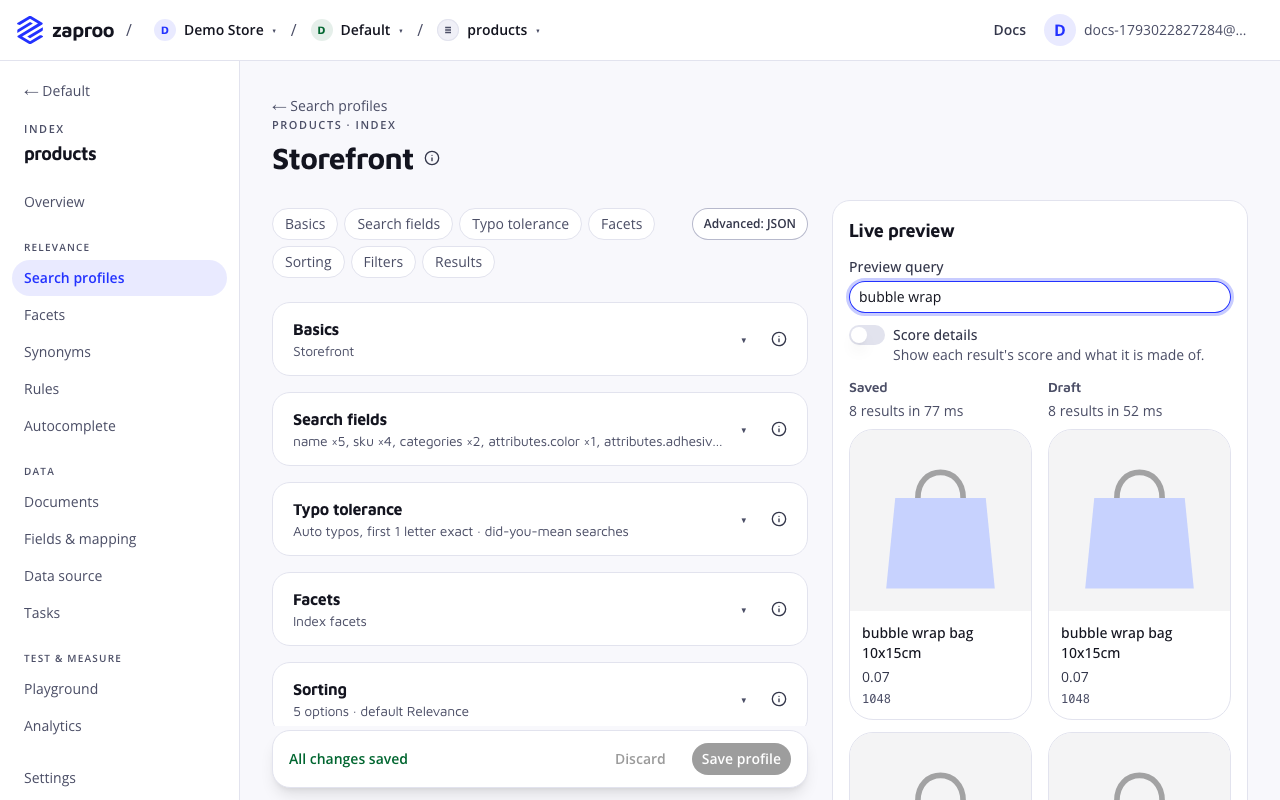
  2. Fill in the blocks. The buttons at the top jump to each one: Basics, Search fields, Typo tolerance, Facets, Sorting, Filters and Results. Every setting is explained further down this page.
  3. Type a search under Preview query in the Live preview on the right. Saved shows the results with the stored profile and Draft with your changes.
  4. Click Save profile. When something blocks the save, the save bar says how many problems to fix, and the jump button of each block with a problem gets a red dot.

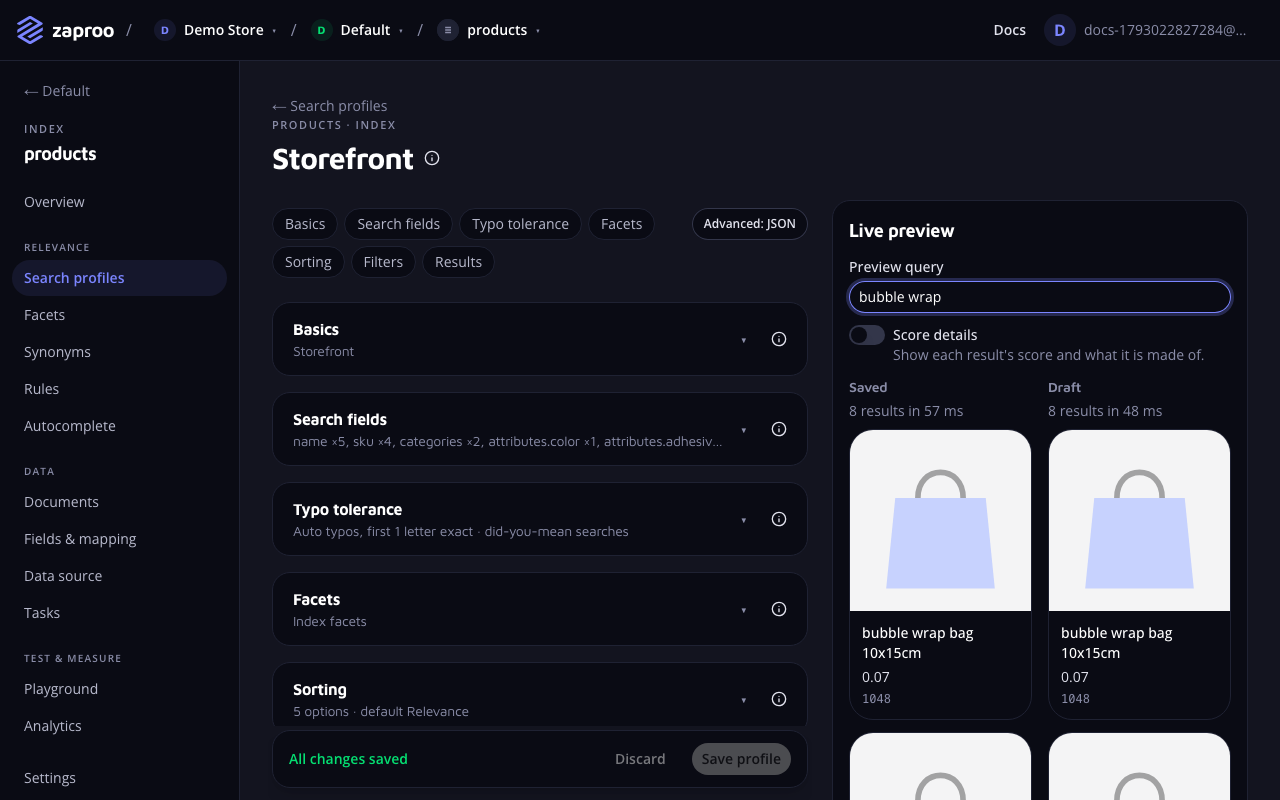
The profile editor for the Storefront profile with blocks for basics, search fields, typo tolerance, facets and sorting, next to a live preview comparing saved and draft results for bubble wrapThe profile editor with a live preview of the saved and the draft settings

Advanced: JSON shows the same profile as JSON, the way the API takes it. Back to blocks returns to the blocks. Discard drops your unsaved changes.

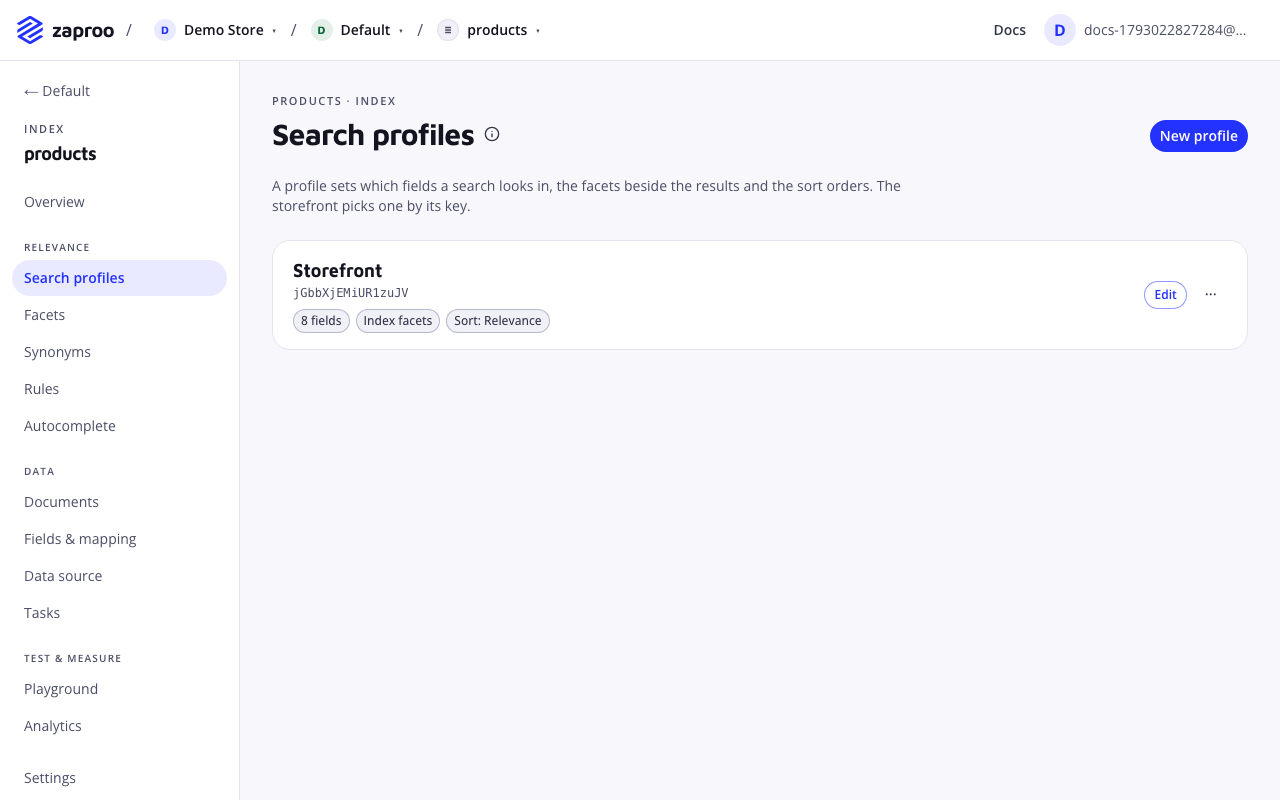
The Search profiles list shows each profile with its key under the name, and chips for its fields, its facets and its default sort. The Basics block of a saved profile shows the key too, with a Copy button. Give this key to whoever builds the storefront search.

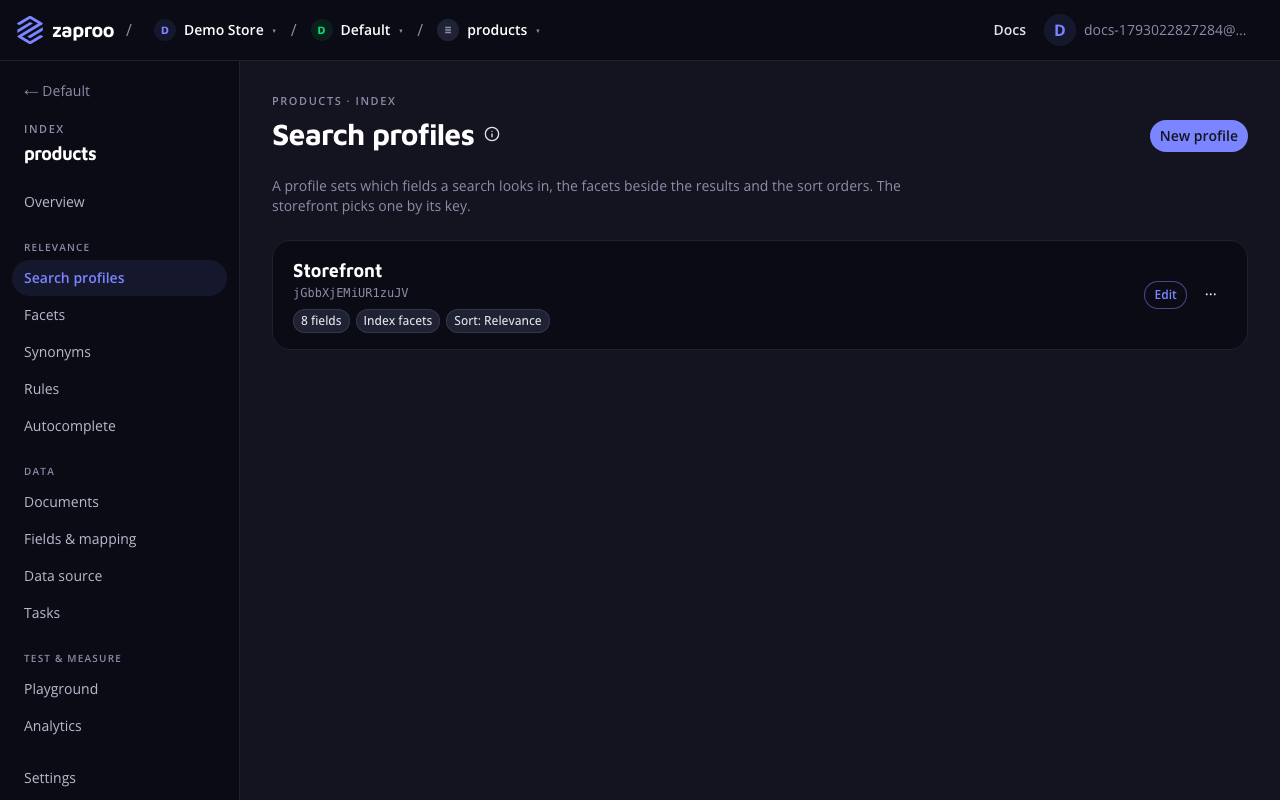
The Search profiles list with one profile, Storefront, its profile key and the chips 8 fields, Index facets and Sort: RelevanceThe profile key sits under the profile name

To check a profile against real searches after you save it, use the playground.

Duplicate or delete a profile

Open the row menu (⋯) next to Edit in the list:

  • Duplicate saves a copy named "Storefront (copy)" and opens it. The copy gets its own profile key.
  • Delete asks you to confirm. Searches that use the profile's key stop working, so switch the storefront to another key first.

With the API

GET/v1/projects/:projectId/indices/:indexId/profilesProject member or any secret keyPOST/v1/projects/:projectId/indices/:indexId/profilesProject admin or a full-access secret keyPUT/v1/projects/:projectId/indices/:indexId/profiles/:profileIdProject admin or a full-access secret keyDELETE/v1/projects/:projectId/indices/:indexId/profiles/:profileIdProject admin or a full-access secret key

The profile is plain JSON, the same as in the editor's JSON view, and its key comes back as profileKey. The storefront calls POST /v1/search/<profileKey>, see the Search API. PUT replaces the whole profile, so send every setting you want to keep. A save checks the profile against the index mapping: a field must exist and carry the flag its use needs (searchable, facetable, filterable, sortable or returnable), or the API answers 400 PROFILE_INVALID with one issue per field. From an AI agent, the MCP tool upsert_profile creates or changes a profile.

Basics

Name

nameType stringValues 1 to 100 characters

What it does

The name you and your team know the profile by. It shows in the cabinet; shoppers never see it.

Best practices and common mistakes

  • Name a profile after where it is used ("Storefront search", "Mobile app"), not after its settings. Settings change, the placement does not.
  • Names are unique within an index. Saving a second profile with the same name answers 409 PROFILE_NAME_TAKEN.

Search fields

Fields and weights

queryFieldsType field → weightValues weights above 0, up to 100; at least one field

What it does

The fields a query looks in, each with a weight. A match in a field with weight 3 counts three times as much as a match in a field with weight 1. Only searchable fields can be listed.

Best practices and common mistakes

  • Give the product title the highest weight and keep long descriptions low. A word in a description says much less about a product than the same word in its title.
  • Add brand and SKU fields with a modest weight so "acme" or a part number finds the right products.
  • A field left out here is not searched at all, even when it is searchable in the mapping.
  • In a language group, the other stores' text has its own list under the store's fields, headed From other stores in the language group, with fields like title · from English (US). Keep their weights below the store's own fields.

Related

Match

matchType all | any | allWordsDefault all

What it does

all returns a product only when every word of the query matches in the same field. any is happy with one word. allWords needs every word too, but each word may match in a different field. all gives precise results for short queries. any returns more products and ranks those that match more words higher.

Best practices and common mistakes

  • With all, every word has to be found in the same field. "acme mailer" matches a title that holds both words, but not a product whose brand is Acme and whose title only says mailer. allWords matches that product, because "acme" is found in the brand and "mailer" in the title.
  • Pick allWords when your catalog splits words across fields, for example a size in the title and the product type in the description. Every word must still match, so it returns far fewer loose hits than any.
  • With allWords on a field that splits numbers, a query word like "300x200" also finds "300x200x150mm". The other two modes look for "300x200" as one word.
  • With allWords, a query of five or more words still matches when one word is missing. Pasted product titles often hold one word the catalog spells differently.
  • Watch the zero-result rate in Analytics after switching to all. Long natural-language queries are the first to stop matching.

Phrase boost

phraseBoostType numberDefault 2Values 0 to 100; 0 turns it off

What it does

An extra boost for products where the query's words appear next to each other, in order. It only lifts products that already match; it never adds new ones.

Best practices and common mistakes

  • The default of 2 helps queries like "packing tape" rank packing tape above packing boxes that mention tape. Raise it when multi-word product names matter, set it to 0 when word order means nothing in your catalog.

Typo tolerance

Typos allowed per word

typo.fuzzinessType AUTO | 0 | 1 | 2Default AUTO

What it does

How many letters may differ between a query word and a word in a product. AUTO allows none for words of one or two letters, one typo for words of three to five letters and two for longer words. 0 turns typo tolerance off.

Best practices and common mistakes

  • Keep AUTO for most catalogs. A fixed 2 lets short words match far too much: two changed letters turn a three-letter word into almost any other.
  • Use 0 for catalogs searched mostly by codes, where a single changed character is a different product.

Related

Exact letters at the start

typo.prefixLengthType numberDefault 1Values 0 to 10

What it does

How many letters at the start of a word must be typed exactly before typos are allowed. With 1, "lamp" can match "lump" but not "damp".

Best practices and common mistakes

  • People rarely mistype the first letter, so 1 cuts false matches at almost no cost. 2 or 3 makes search faster on very large catalogs and stricter still.
  • 0 lets the first letter differ too, which mostly adds noise.

Did you mean

didYouMean.enabledType booleanDefault true

What it does

When a search finds nothing, the engine looks for a corrected spelling of the query among the words in your products. The response returns it as correctedQuery, so the storefront can show "Did you mean …?".

Best practices and common mistakes

  • It only runs when a search has zero results, so it costs nothing on searches that already find products.

Related

Search the suggestion

didYouMean.replaceOnNoResultsType booleanDefault true

What it does

With this on, a search that finds nothing is run once more with the corrected query, and the response returns those results with correctedQuery set. Off, the response stays empty and only carries the suggestion.

Best practices and common mistakes

  • When it is on, tell the shopper what happened: "Showing results for lamp". Results for a different word without a word of explanation look like a bug.
  • The corrected search is never corrected a second time, and ranking rules match the corrected query.

Facets

Profile facets

facetsType list of facetsDefault the index facetsValues up to 50

What it does

The filter panels next to the results, in order. Leave the setting out and the profile shows the index facets, which you manage once on the index's Facets page. In the Facets block, Customize for this profile gives the profile its own list, and Use the index facets goes back. Set it, even to an empty list, and this profile shows its own facets instead.

A facet has a type and a facetable field, and an optional label:

  • terms: the field's values with product counts; limit 1 to 500 (default 20), order count or key.
  • range: buckets you define with from and to; from is included and to is not. Up to 50 buckets, numeric fields only.
  • stats: the lowest and highest value in the results, for a price slider. Numeric fields only.
  • hierarchy: a category tree that shows the children of the deepest selected category; limit 1 to 500 (default 50). Hierarchy fields only.

Best practices and common mistakes

  • Use the index facets unless a profile really needs different ones. One list is easier to keep right than several copies.
  • Facet counts stay disjunctive: ticking one brand keeps the counts of the other brands, so the shopper can add a second one.
  • A facet's field may be filtered by requests automatically; it does not need to be listed under extra filterable fields.

Related

Hide empty facets

hideEmptyFacetsType booleanDefault true

What it does

Leaves out facets with nothing to pick for the current search. A facet the request already filters on stays even when it is empty, so the shopper can still see and clear the selection.

Best practices and common mistakes

  • Turn it off only when your storefront needs every facet in a fixed position, for example in a layout with a slot per facet.

Sorting

Sort options

sortOptionsType list of sortsDefault ["_relevance"]Values 1 to 50 options

What it does

The sort orders a shopper can pick. Each option is up to 10 clauses joined by commas and applied in order: _relevance (best match first) or field:asc / field:desc on a sortable field, for example price:asc or inStock:desc,_relevance. A field may appear once per option. A request asking for a sort that is not in this list answers 400 SORT_NOT_ALLOWED.

Best practices and common mistakes

  • Keep _relevance in the list. Without it, a shopper who picked "price, low to high" cannot get back to best matches.
  • Products that tie on a field sort (equal prices) fall back to the best match first, so you do not need to add _relevance at the end yourself.

Related

Default sort

defaultSortType sortDefault _relevance

What it does

The sort used when a request does not ask for one. It must be one of the sort options, or the save fails.

Best practices and common mistakes

  • Leave the search page on _relevance. A category page with an empty query is a good place for a field sort such as newest first.

Always show first

pinnedSortType list of sort clausesDefault []Values up to 10 clauses

What it does

Sort clauses that lead every search, before the default or the requested sort, such as inStock:desc to show products in stock first. A clause of the chosen sort on the same field is dropped, since it would change nothing after the pinned one.

Best practices and common mistakes

  • In-stock first is the classic use. Keep the list short: each clause pushes relevance further down.
  • Ranking rules that pin products only take effect when, after these clauses, results are ordered by relevance.

Filters

Always-on filters

filtersType field → filterDefault {}

What it does

Filters every search gets. A product shows up only when it matches all of them, and the storefront cannot lift them. A filter is a value, a list of values (any of them), a range {"gte": 10, "lt": 50}, {"exists": true} or category nodes {"terms": ["Boxes>Mailers"]}, on a filterable or facetable field.

Best practices and common mistakes

  • Use one to give a profile its own slice of the index, such as {"inStock": true} for a shop that never shows sold-out products.
  • These filters narrow facet counts too, so facets never offer values that cannot be shown.

Related

Exclusions

exclusionFiltersType field → filterDefault {}

What it does

Products that match any of these never show up, whatever the request asks for. They take the same filter forms as always-on filters.

Best practices and common mistakes

  • Good for hiding a brand or a category from one storefront without deleting it from the index. To hide single products for chosen searches, a ranking rule is the better tool.

Extra filterable fields

filterFieldsType list of fieldsDefault []Values up to 100

What it does

Fields a request may filter on besides the facet fields. A request filtering on any other field answers 400 FILTER_NOT_ALLOWED, which keeps storefront requests from filtering on fields you did not mean to expose.

Best practices and common mistakes

  • Add a field here when the storefront filters without showing a facet, such as a hidden currency or a visibility flag.

Results

Fields in each hit

fieldsType list of fieldsDefault every returnable fieldValues up to 200

What it does

The fields each hit returns. Leave it out and a hit carries every returnable field of the mapping.

Best practices and common mistakes

  • List only what the result card shows (title, price, image, URL). Smaller responses render faster, especially on mobile.

Results per page

perPage.defaultType numberDefault 24Values 1 to 1000

What it does

How many hits a page holds when the request does not say. It cannot be higher than the most a request may ask for.

Best practices and common mistakes

  • Pick a number that fills whole rows of your grid: 24 works for 2, 3, 4 and 6 columns.

Most a request may ask for

perPage.maxType numberDefault 100Values 1 to 1000

What it does

The largest perPage a request may send; above it the API answers 400 PER_PAGE_TOO_LARGE. Independently, a page must start within the first 10,000 results.

Best practices and common mistakes

  • Keep it low on public storefronts. A high limit lets anyone pull large result pages with a public key.